The Jagannath Rath Yatra in Puri, Odisha, is one of the most colorful and significant religious festivities in all of India. Held annually in Puri, Odisha, this sacred event—also known as the Jagannath Rath Yatra Puri—marks the ceremonial journey of Lord Jagannath, along with Lord Balabhadra and Goddess Subhadra, from the Jagannath Temple to the Gundicha Temple.
Millions of devotees gather to witness and participate in this divine procession, making Rath Yatra Puri Odisha not just a religious festival, but a global cultural phenomenon rooted in devotion, equality, and tradition. The 2026 edition will be even bigger and more majestic, with the elaborate rituals and cultural performances of the previous years, while an ocean of devotees chant “Jai Jagannath!”
What Is Rath Yatra and Why Is It Celebrated?
The Rath Yatra Puri Jagannath festival symbolizes the Lord’s desire to step out of the sanctum and meet devotees directly. Unlike most Hindu rituals where deities remain inside temples, Rath Yatra allows people from all walks of life to pull the sacred chariots—an act believed to grant spiritual merit and liberation.
Celebrated on Ashadha Shukla Dwitiya (June–July), the Rath Yatra reflects divine movement, inclusion, and the timeless bond between God and devotee.
Historical and Religious Significance of Rath Yatra
The origins of Jagannath Rath Yatra Puri date back thousands of years and are deeply connected to Sanatana Dharma. According to legend, Lord Jagannath visits the Gundicha Temple—considered his maternal home—once a year.
The festival is also associated with:
- Lord Krishna’s journey from Gokul to Mathura
- The philosophy of equality and universal devotion
- Moksha (liberation) through darshan and service
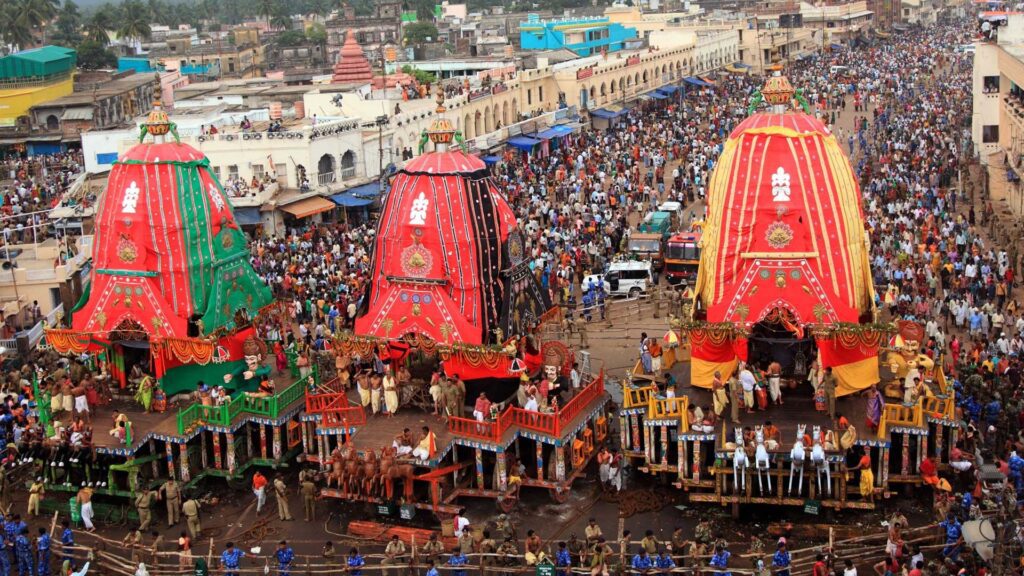
Each year, the chariots are constructed anew using sacred neem wood (Daru Brahma), following age-old rituals and measurements preserved by temple servitors.
The Three Sacred Chariots of Rath Yatra Puri Odisha
One of the most iconic elements of Rath Yatra Puri is the grand construction of three massive wooden chariots:
Nandighosa – Chariot of Lord Jagannath
- 16 wheels
- Red and yellow canopy
- Represents supreme consciousness
Taladhwaja – Chariot of Lord Balabhadra
- 14 wheels
- Red and green canopy
- Symbol of strength and protection
Darpadalana – Chariot of Goddess Subhadra
- 12 wheels
- Red and black canopy
- Represents divine energy and compassion
These towering chariots dominate the Bada Danda (Grand Road) of Puri during the festival.
Key Rituals and Celebrations During Rath Yatra 2025
The 2025 Rath Yatra will adhere to centuries-old traditions. The festival will commence with the Snana Yatra (divine bath) ceremony and the Chhera Pahanra (sweeping of the chariots by the Gajapati King). The Rath Yatra’s core event will feature the presentation of the deities carried to the chariots through the sacred Pahandi ceremony, accompanied by the rhythmic beats of the drums and the chanting of the devotees.
Thousands of individuals will gather at one location to see the festival’s vibrant procession along Bada Dana (Grand Road) as the chariots are pulled for everyone to admire. The Rath Yatra takes place over nine days: each day includes a return journey called Bahuda Yatra, and the grand finale features Suna Besha (dressing the deities in gold). For those gathered, tasting the festival’s Mahaprasad (holy offering) is always a rewarding and meaningful experience everyone enjoys.
Why Rath Yatra Puri Is a Once-in-a-Lifetime Experience
The Rath Yatra Puri Odisha experience is unmatched—towering chariots, rhythmic chants of “Jai Jagannath”, and millions of devotees moving in unison create an atmosphere of pure transcendence.
Whether you seek spiritual blessings, cultural immersion, or a deeper understanding of India’s living traditions, Rath Yatra Puri Jagannath offers an unforgettable journey of faith.
Travel Guide for Rath Yatra 2025 in Puri
Planning to attend the Rath Yatra Puri 2025 in Puri? Here’s a quick guide:
- Best Time to Visit: The festival falls in June/July; arrive a day early to secure accommodation.
- Where to Stay: Book hotels in Puri or nearby Bhubaneswar in advance.
- Transport: Trains and buses connect Puri to major cities; expect heavy crowds.
- Dos & Don’ts: Follow temple guidelines, dress modestly, and avoid plastic near chariots.
- Must-See: The chariot pulling, evening aarti, and cultural performances.
Important Dates for Rath Yatra Puri 2025
Akshya Tritiya (April 30, 2025):
This ceremony marks the official initiation of the Rath Yatra preparations. Construction on the chariots for the prestigious Rath Yatra festival in Puri occurs on Akshaya Tritiya, a highly auspicious day. On this day, in all traditions, the first logs of wood are brought or transported for the construction of the gigantic chariots of Lord Jagannath, Balabhadra, and Subhadra.
Snana Purnima (June 11, 2025):
On this day, we bring the lordships out of the temple and ceremonially bathe the deities with the waters from the Golden Well (which are collected in 108 pots of water). In this event, devotees can see the deities. After the ceremonial bath, the deities are dressed in a special costume called “Gaja Besha”, i.e., like they are elephants.
Anavasara (June 13 – 26, 2025):
Following Snana Purnima, the deities do not receive worship for 15 days. They are believed to have ‘caught a cold’ following their bath, thus need to be tended to and make them comfortable. This is also a time when the temple is closed to the public and when special herbal treatment is given to the deities.
Gundicha Marjana (June 26, 2025):
On the day before the actual RathYatra, the Gundicha Temple is cleansed and made ready for the deities to inhabit. The practice is a process of cleansing the heart to receive the divine.
Rath Yatra (June 27, 2025):
The central event occurs as the deities are carried out in a grand procession (the Pahandi) and seated onto the chariots; now let the common event occur. The grand procession begins as thousands of devotees pull the chariots along the Bada Danda (the Grand Road) to the Gundicha Temple, which is located approximately three kilometers away.
To pull the chariots is to obliterate sin and bestow blessings. As the deities are on their chariots, the King of Puri performs the ‘Chhera Panhara, ’ which involves sweeping the chariot platforms with a broom made of gold; this is very important because it reminds everyone that God has no distinction among human beings.
Hera Panchami (July 1, 2025):
On the fifth day of the deities residing at the Gundicha Temple, people believe that the Goddess Lakshmi, spouse of Lord Jagannath, comes to see him. Hera Panchami is the custom of Goddess Lakshmi searching for her husband and a playful game between representatives of the deities.
Sandhya Darshan (July 3, 2025):
It is said that seeing the deities at the Gundicha Temple in the evening is of the highest importance. The literature says that one sees the deities at the Gundicha Temple for an evening, it would be like seeing the deities for ten years at the main temple.
Bahuda Yatra (July 5, 2025):
The event of transporting the deities from the Gundicha Temple back to the Jagannath Temple is called Bahuda Yatra. When the chariots return, they also stop at the Mausi Maa Temple and receive ‘Poda Pitha,’ a type of baked cake.
Suna Besha (July 6, 2025):
On the day after Bahuda Yatra, the deities are decked with golden ornaments for Suna Besha. It is one of the most spectacular sights and the deities are dressed in gold.
Adhara Pana (July 7, 2025):
Adhara Pana is a type of sweet beverage that’s particularly presented to the Jagannath, Balabhadra, and Subhadra gods on the chariots during Rath Yatra. It is made in a large earthen jar containing milk, cheese, sugar, and spices. Very large earthen jars are prepared and serve the drink.
Once they serve the drink, the pots are broken, symbolizing that everything belongs to everyone. Adhara Pana presentation is a way to express heartfelt gratitude to the deities, but it is also an act of cutting one’s ego to reduce ego-based attachments.
Niladri Bijay (July 8, 2025):
The installation of the deities in the Jagannath Temple sanctum sanctorum is the last event. It is the last festival event indicating the deities have returned to their proper place in the temple.
Conclusion
The Jagannath Rath Yatra Puri is not just a festival—it is a living spiritual tradition that has endured for centuries. As Rath Yatra Puri 2025 approaches, devotees and travelers alike prepare to witness a divine celebration that unites faith, history, and humanity.